



내로남불의 또다른 극치
작성일 : 2026-01-21 19:12 수정일 : 2026-02-07 09:50 작성자 : 이 천석 대기자 (cheonsuk@gmail.com)
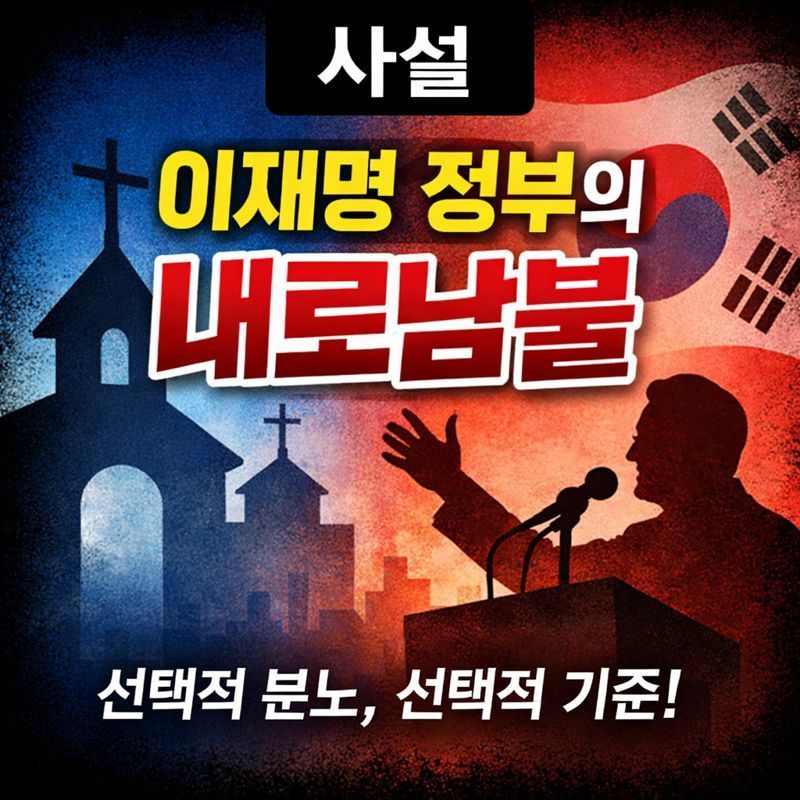
[이천석의 사설] 선택적 분노, 선택적 정의 — 이재명 정부의 종교 탄압 프레임은 내로남불의 극치다
이재명 대통령이 최근 일부 교회에서 나온 극단적 발언을 사례로 들며 기독교 전반을 문제시하는 태도를 보이고 있다. 폭력적 표현은 어떠한 경우에도 정당화될 수 없으며, 종교를 막론하고 규탄되어야 한다는 점에서 이는 분명한 원칙이다. 문제는 그 원칙이 과연 일관되게 적용되고 있는가이다.
기독교 일부에서 “대통령을 죽여야 한다”는 과격한 발언이 나왔다는 이유로 종교 전체를 잠재적 위험 집단으로 일반화하는 순간, 국가는 표현의 자유와 종교의 자유를 침해하는 위험한 길로 접어든다. 더 심각한 것은 같은 잣대가 다른 종교·다른 정치적 진영에는 적용되지 않는다는 점이다.
실제로 일부 천주교 성당과 집회 현장에서도 “윤석열은 죽어야 한다”는 취지의 과격 발언이 공개적으로 표출된 바 있다. 그렇다면 질문은 단순하다. 왜 그 발언들은 체계적 문제로 확대되지 않았는가? 왜 그때는 ‘개인의 일탈’로 치부되었고, 지금은 ‘종교 전체의 위험성’으로 비약되는가?
이는 전형적인 내로남불이다. 폭력적 언사는 어느 편에서 나오든 동일한 기준으로 규율되어야 한다. 그러나 현 정부의 태도는 정치적 유불리에 따라 분노의 방향과 강도를 조절하는 듯 보인다. 법치의 핵심은 결과가 아니라 과정과 기준의 공정성에 있다. 기준이 흔들리는 순간, 법치는 권력의 도구로 전락한다.
더욱 우려스러운 대목은, 이러한 선택적 사례 제시가 종교 탄압의 명분 쌓기로 기능할 수 있다는 점이다. 소수의 과격 발언을 빌미로 특정 종교 공동체를 압박하고 낙인찍는다면, 이는 민주사회가 가장 경계해야 할 집단적 책임 전가다. 국가 권력이 종교를 관리·감시의 대상으로 규정하는 순간, 자유는 급속히 위축된다.
정부가 해야 할 일은 명확하다.
첫째, 폭력 선동은 종교·이념을 불문하고 개별 행위로 엄정 처벌하라.
둘째, 종교 전체를 일반화하는 프레임 정치를 즉각 중단하라.
셋째, 동일한 기준을 모든 진영에 적용하라. 그것이 법치다.
정치는 갈라치기의 기술이 아니다. 정의는 선택될 수 없고, 분노는 편파적이어서는 안 된다. 이재명 정부가 진정으로 민주주의와 자유를 말하려 한다면, 지금 당장 자기편의 과격 발언부터 동일한 잣대로 직시해야 한다. 그렇지 않다면, 오늘의 프레임은 내일의 탄압으로 되돌아올 것이다.
[대전=더뉴스라인 이천석 대기자]
여러분의 후원(MG새마을금고 9003-3089-9326-6)이 펜의 힘을 높입니다.
[C.S.Lee's Editorial] Selective Outrage, Selective Justice — The Lee Jae-myung Government’s Dangerous Double Standard
President Lee Jae-myung has recently signaled an aggressive posture toward Christianity, citing extremist remarks allegedly made in some churches as justification. There is no dispute that calls for violence against any individual—regardless of politics—are unacceptable and must be condemned without hesitation. On this principle, there can be no ambiguity.
The problem lies elsewhere: Is this principle being applied consistently?
When isolated extremist statements are used to portray an entire religious community as a threat, the state crosses a dangerous line—one that undermines freedom of religion and freedom of expression. Even more troubling is the government’s apparent willingness to generalize in one direction while remaining conspicuously silent in another.
Public records and media coverage show that, in some Catholic parishes and political gatherings, similarly extreme rhetoric—such as calls implying that former President Yoon Suk-yeol “deserved to die”—has also surfaced. Yet these incidents were neither elevated into a broader indictment of Catholicism nor framed as a systemic danger to the republic. They were dismissed as individual excesses.
This raises an unavoidable question: Why is one set of extremist remarks treated as proof of a collective problem, while another is brushed aside as mere deviation?
The answer points to a familiar pattern in Korean politics—selective outrage and selective justice. If the rule of law is to retain legitimacy, it must be blind to ideology, religion, and political alignment. When standards shift depending on who speaks and whom the speech targets, law enforcement becomes an instrument of power rather than a guardian of justice.
More alarming still is the precedent such framing sets. By accumulating selective examples, the government appears to be constructing a moral pretext for broader pressure on a specific religious group. History shows that once a state begins to treat religion as an object of surveillance and suspicion rather than a protected freedom, democratic norms erode rapidly.
A democratic government has a clear obligation:
First, prosecute incitement to violence strictly as individual criminal conduct, regardless of political or religious context.
Second, reject all attempts to generalize the actions of a few into collective guilt.
Third, apply the same legal and moral standards to every camp—without exception.
Justice cannot be partisan. Outrage cannot be curated. And freedom cannot survive selective enforcement.
If the Lee Jae-myung administration truly claims to stand for democracy and the rule of law, it must begin by scrutinizing extremism within its own ideological allies with the same rigor it applies to its critics. Otherwise, today’s rhetoric will be remembered not as governance, but as the first step toward politically motivated repression.
칼럼 최신 기사
- 대전의 미래, 이제는 ‘계획’이 아니라 ‘완성’의 시간 - 이장우 시정의 추진력이 만든 변화와 다음 4년의 선택
- AI의 적정 주가, 3800대
- 성과급 논란... 우리나라는 사회주의가 아니다.
- 안동에서 정상회담, 과연 이재명답다!!!
- 선거의 진짜 승부처, 단톡방과 SNS에서 결정
- 댓글 하나가 당락 가른다… 초박빙 6.3 지방선거의 승부처는 ‘소통’
- 〈대전시 중구 10대 핵심 현안 분석〉 교통편 막히는 도시를 뚫어야 중구의 미래가 열린다
- AI 시대의 정치 홍보, 이제는 “확장력”이 승패를 결정
- 투표(投票)는 바람에 흔들리지만 유권자의 본심(本心)은 변하지 않는다
- 〈대전시 중구 10대 핵심 현안 분석〉 제4탄 정치·행정편 말보다 결과가 필요한 중구, 이제 실행이 관건
- 검사가 어쩌다 이지경까지 왔나
- AI 시대에 걸맞은 선거제도 개선이 필요, 이제는 ‘금지의 선거’와 결별할 때
- 〈대전시 중구 10대 핵심 현안 분석〉 제3탄 문화·예술편 도시는 결국 문화, ‘대전 중구’ 다시 문화도시로 살아나야 한다.
- 로또1등당첨! 삼성전자 초기업 노조원들
- 미워도 국민의힘, 민주당은 절대 안된다!!!
- 〈대전시 중구 10대 핵심 현안 분석〉 제2탄 경제편 원도심 경제 회복은 도시 생존의 문제, 대전 중구 경제의 위기
- 청년이 머무는 도시, 교육이 미래가 되는 대전
- 소통과 공감이 만들어낸 작은 행운, 목욕탕의 효자손
- "국회의장은 조정식" 李대통령, SNS에 지지자 글 공유…경선 개입
- 악의 집권, 악의 축이 되나?